-
Dubberly Design Office
2501 Harrison Street, No. 7
San Francisco, CA 94110 -
415 648 9799 phone
415 648 9899 fax
Concept Maps
We create concept maps, a type of model,
to explore and learn about complex information spaces.
By showing everything—the forest and the trees—in a single view,
concept maps help people create mental models and clarify thoughts.
We create concept maps to share understanding—
with our clients, peers, and others interested in the subjects.
Please note: many of our concept maps are poster size.
They can be printed at smaller sizes (11 x 17), but may be difficult to read.
A few of the maps have been printed and are available through our office.
Mar 4, 2011
The 892 unique ways to partition a 3 x 4 grid
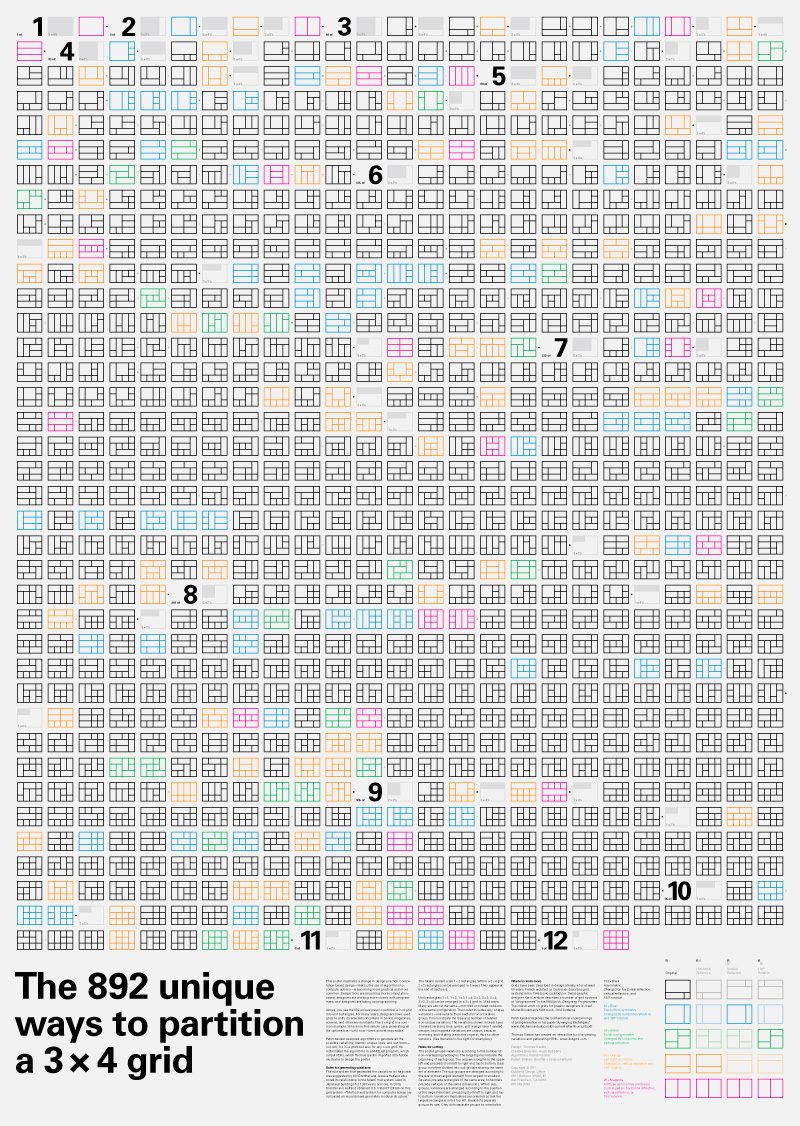
Designed by Thomas Gaskin.
Creative direction by Hugh Dubberly.
Algorithms by Patrick Kessler.
Patent belongs to William Drenttel + Jessica Helfand.
This poster illustrates a change in design practice. Computation-based design—that is, the use of algorithms to compute options—is becoming more practical and more common. Design tools are becoming more computation-based; designers are working more closely with programmers; and designers are taking up programming.
Above, you see the 892 unique ways to partition a 3 × 4 grid into unit rectangles. For many years, designers have used grids to unify diverse sets of content in books, magazines, screens, and other environments. The 3 × 4 grid is a common example. Yet even in this simple case, generating all the options has—until now—been almost impossible.
More…Mar 16, 2010
Creating Concept Maps
A concept map is a picture of our understanding of something. It is a diagram illustrating how sets of concepts are related. Concept maps are made up of webs of terms (nodes) related by verbs (links) to other terms (nodes). The purpose of a concept map is to represent (on a single visual plane) a person’s mental model of a concept.
Mar 20, 2009
A Model of The Creative Process
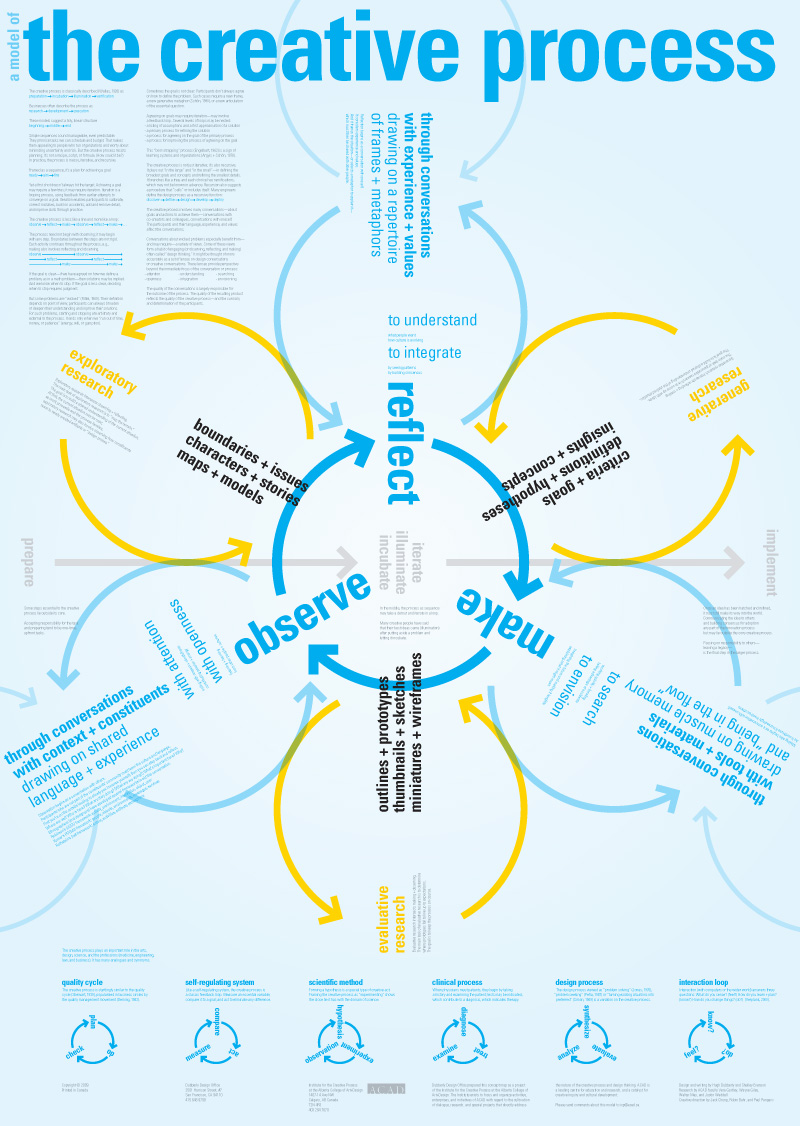
*Created in collaboration with Jack Chung, Shelley Evenson, and Paul Pangaro.*
The creative process is not just iterative; it’s also recursive. It plays out “in the large” and “in the small”—in defining the broadest goals and concepts and refining the smallest details. It branches like a tree, and each choice has ramifications, which may not be known in advance. Recursion also suggests a procedure that “calls” or includes itself. Many engineers define the design process as a recursive function:
discover > define > design > develop > deploy
Feb 17, 2009
The Ballot Ecosystem
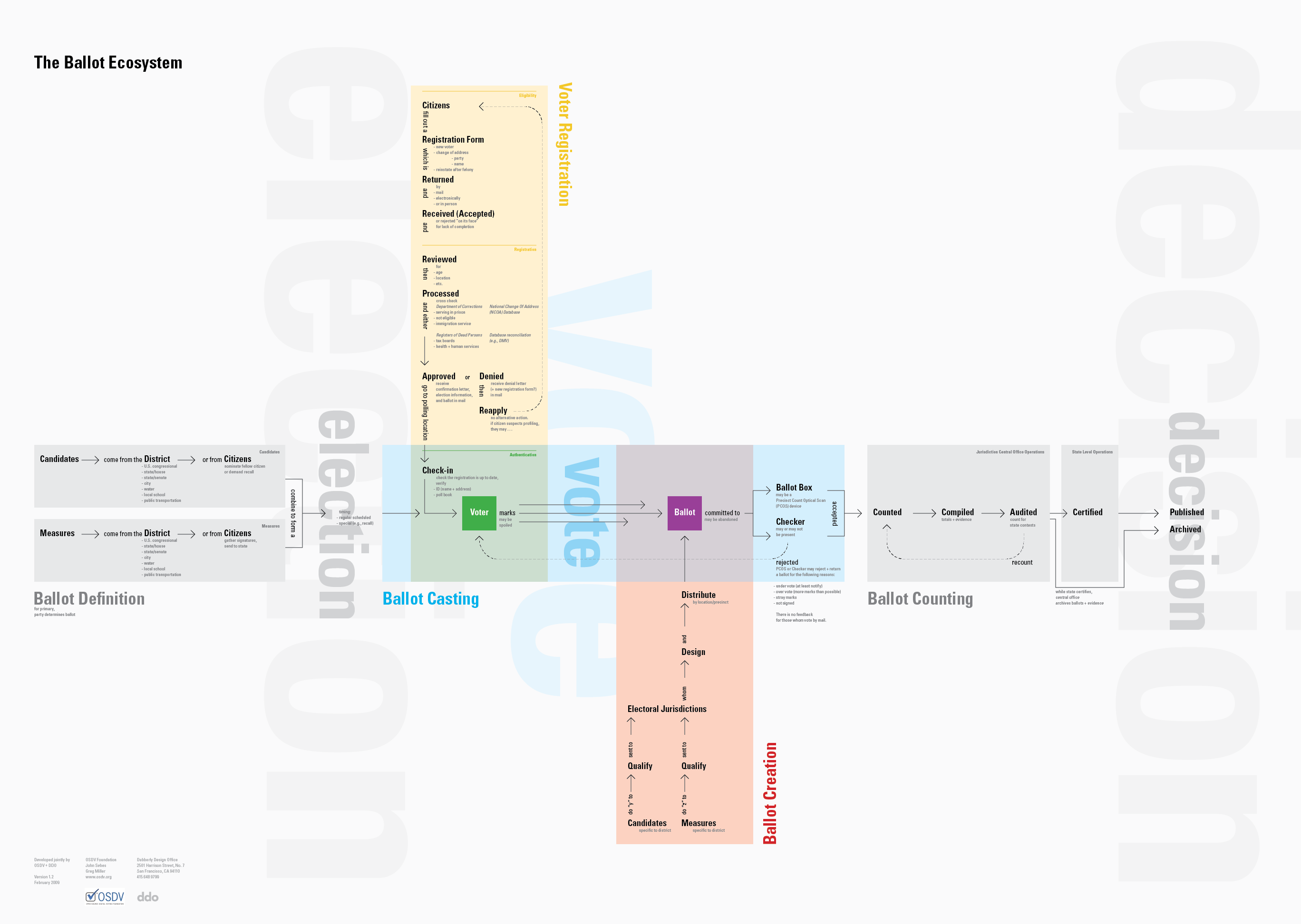
An election is a complex process with several steps involving many components. This concept map provides a general overview.
More…Mar 11, 2008
A Model of Play

*Created in collaboration with Satoko Kakihara, Jack Chung, and Paul Pangaro.*
This model is built on the idea that play is a type of conversation. It involves two individuals, who might also be teams, or points of view with in a single person, or a virtual person and a real person. Through conversation, they create a shared world in their imaginations, which leads to fun.
Mar 29, 2007
A Model of Innovation
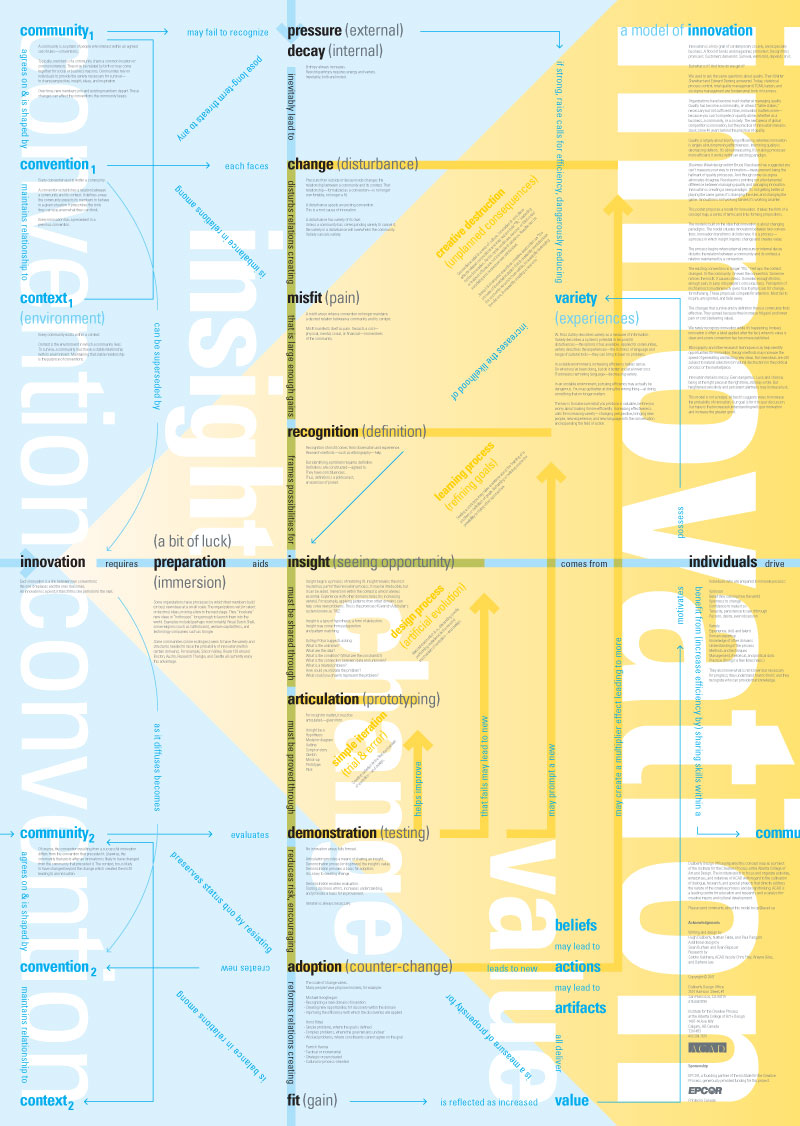
*Created in collaboration with Sean Durham, Ryan Reposar, Paul Pangaro, and Nathan Felde.*
This model is built on the idea that innovation is about changing paradigms. The model situates innovation between two conventions. Innovations transform old into new. It is a process—a process in which insight inspires change and creates value.
Jul 28, 2004
How Organizations Track Customers
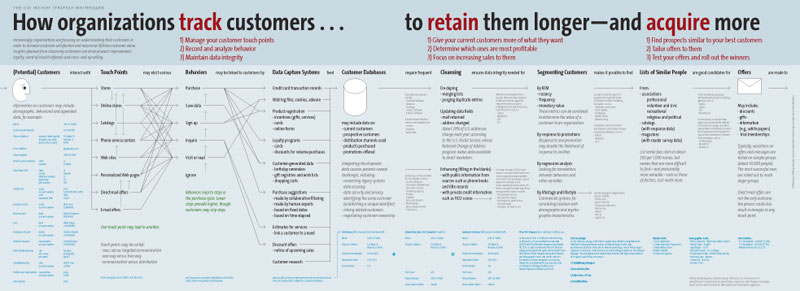
Increasingly, organizations are focusing on understanding their customers to increase customer satisfaction and to maximize lifetime customer value. Insights gleaned from observing customers can drive product improvement, loyalty, word-of-mouth referrals and cross- and upselling.
Aug 2, 2003
Domain Name System

Created in collaboration with Paul Devine.
The domain name system stores and associates many types of information with domain names, but more importantly, associates domain names (computer hostnames) to IP addresses. DNS is a system vital to the smooth operation of the Internet.
The goal of this diagram is to explain what DNS is, how it works, and how it’s governed. The diagram knits together many facts about DNS in hopes of presenting a comprehensive picture of the system and the context in which it operates.
More…Jul 29, 2003
A Model of a Heart Attack
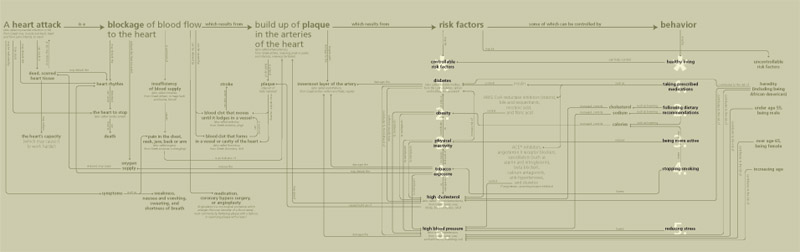
*Created in collaboration with Audrey Crane.*
For many years, Stanford University Cardiac Rehabilitation Program (SCRP) has conducted research on ways to change the behavior of patients who have had heart attacks. Their research is aimed at reducing the risk of a patient having another heart attack. Educating patients and their families is a key component of changing patient behavior.
Feb 14, 2003
Java Technology
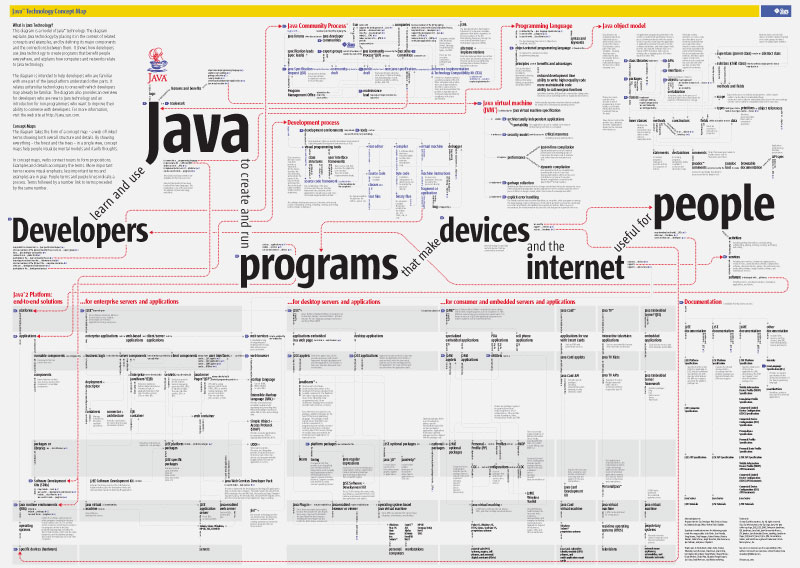
*Created in collaboration with Audrey Crane, Jim Faris, and Harry Saddler.*
This diagram explains Java by placing it in the context of related concepts and examples, and by defining its major components and other connections between them.